
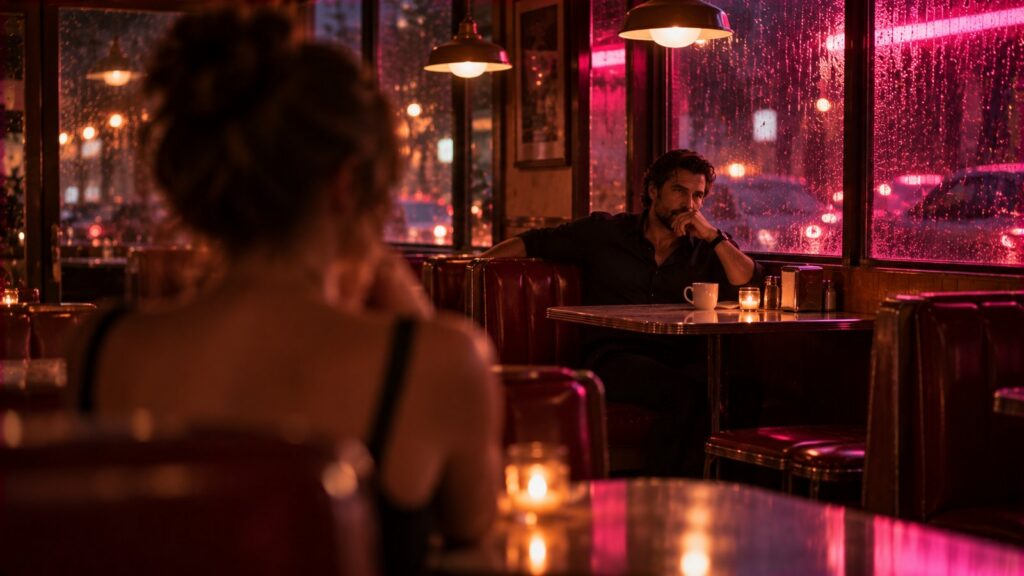
Everyone in the city knew not to look at Luca Moretti for too long. He was the kind of man rooms went quiet around, the kind whose name people said carefully, like it might hear them. I ran a small all-night diner near the water, and for eleven months he had come in at exactly the same time, sat in the same corner booth with his back to the wall, and ordered black coffee and whatever I told him was good that night.
To the rest of the world he was dangerous. To me, somehow, he was the man who left an absurd tip and always waited until I locked up before his car pulled away, headlights lingering until I was safely inside.
The Man in the Corner Booth
I should have been afraid of him. My common sense certainly was. But there is a difference between what a man is to the world and what he is across a chipped formica table at two in the morning, and I only ever got the second one.
He did not talk much at first. Then one night, slow and empty, rain coming down in sheets, he asked me why I was not scared of him like everyone else. I set down the coffeepot and told him the truth. That a man who watches to make sure a stranger gets home safe is not the same man the rumors describe, whatever else he has done. Something flickered across his face, there and gone, like I had touched a bruise he forgot he had.
After that, he talked. Never about his world, never about the things that made people whisper. About small things. A book he was reading. His grandmother, who raised him. The way the harbor looked at dawn. And I found myself living for two in the morning in a way that frightened me more than he ever had.
The Night It Changed
It broke open on a night the power flickered and the diner emptied early. He stayed while I cleaned, the way he always did, and when I came around the counter he was standing, close, closer than he had ever let himself be.
“You should be afraid of me,” he said, low, like a warning he desperately did not want me to take.
“I know what everyone says you are,” I said. “I also know you have sat in that booth for eleven months and never once made me feel anything but safe. So which one is real, Luca?”
His jaw tightened. For a man the whole city feared, he looked, in that moment, like someone bracing to be turned away.
“With you,” he said roughly, “the dangerous one goes quiet. You are the only place in my life where I am not that man. Do you understand what that does to me?” He lifted a hand, slow enough that I could have stepped back, and brushed a strand of hair from my face like it was the most delicate thing he had ever handled. “I would burn this entire city down before I let anything touch you. And it terrifies me, because I have never had something I was afraid to lose.”
I should have run. Instead I closed the space between us, because I had spent eleven months learning the difference between the man and the myth, and I trusted what I knew.
He kissed me like a man handling something breakable with hands built for anything but. All that danger, all that control, gone gentle for me and me alone. The rain hammered the windows. The neon sign buzzed pink over the empty booths. And the most feared man in the city held me like I was the one thing in the world he could not afford to break.
“Say the word,” he murmured against my lips, “and I am yours. Completely. I do not know how to do this halfway.”
Why the Dangerous Man Trope Grips Us
The dangerous-man fantasy, the mafia king, the feared man gone soft, endures for a reason that has nothing to do with the danger itself.
It is the fantasy of being the one exception. Luca is powerful, feared, closed off to the entire world, and undone by a single person. The thrill is not that he is dangerous. It is that all that formidable strength turns gentle for her and no one else, that she reaches the tender place beneath the armor that everyone else believes is not there. When he says she is the only place he is not that man, he is confessing that she alone gets the real him.
That craving has a name in the real world. Relationship coach James Bauer calls it the Hero Instinct, a man’s deep need to feel that he alone can protect and cherish his woman, that she reaches something in him no one else does. In fiction it comes wrapped in danger and rain and a corner booth. In real life you do not need a man with a dangerous reputation. You can reach that protective, devoted place in a good man once you understand what he is quietly wired to feel. If the pull of this story is familiar, that free explanation of the male mind is the closest real-world version I have found.
The danger is fiction. The longing to be the one who reaches a strong man’s softest self is very real, and it lives in gentler men than this one.