
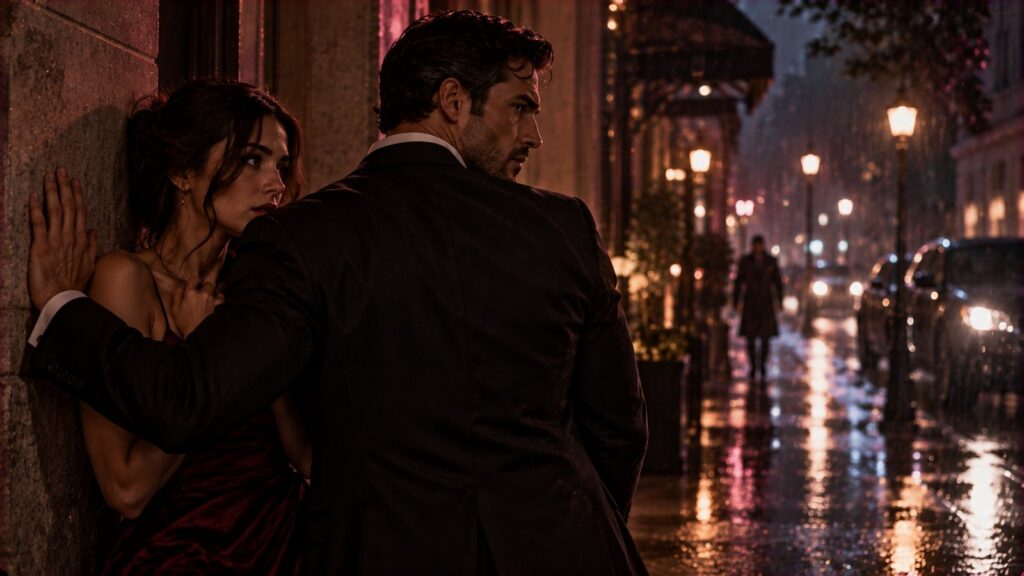
When the threats against my father’s company turned specific, he hired protection for me without asking. That is how Marcus came into my life, six foot something of quiet vigilance who followed me at a respectful distance and said perhaps twelve words a day, all of them about exits and sightlines. I resented him for exactly one week. Then I started noticing the way he positioned himself between me and every door, every stranger, every possible harm, without ever being asked, and the resentment turned into something far more inconvenient.
He was paid to keep me alive. He was not paid to memorize how I take my coffee, or to move a fallen branch off my morning path before I reached it, or to look at me, when he thought I could not see, like I was something he was terrified of losing.
The Man Who Stood Between Me and the World
Marcus was maddeningly professional. He kept his distance, kept his voice level, kept a wall of duty firmly between us. But walls tell you where a person is standing, and his was always, always angled toward me.
“You do not have to walk me to the door of my own bedroom,” I told him one night, half teasing.
“Yes,” he said, in that low even voice, “I do.” A pause. “It is my job.”
“Is that all it is?” I asked, before I could stop myself.
His jaw worked. For a long moment the professional mask held. Then, quietly, “You should go inside. It is late.” Which was not a no, and we both heard that it was not.
The Night the Mask Came Down
It broke the night a car backfired in the street and Marcus had me behind him and against the wall before I understood what had happened, his whole body a shield, one hand flat and protective over my heart, the other braced beside my head. The street went quiet. Nothing. A car, just a car. But he did not step back.
“Marcus,” I breathed.
“Give me a second,” he said, rough, not moving, his forehead dropping until it nearly touched mine. “I need a second where you are safe and I can feel it.”
“You are always keeping me safe,” I whispered.
“Not the way I want to.” The words came out like they cost him everything. “I am supposed to be a professional. I am supposed to keep a distance. And every day I stand between you and the world and think about how I would step in front of anything for you, and it stopped being the job a long time ago.” He finally looked at me, mask entirely gone. “I have no right to say this. But if anything ever happened to you, it would not be a client I lost. It would be the whole reason I was standing there at all.”
I closed the last inch myself, because I was done being protected from the one thing I wanted. When he kissed me, all that careful control broke at once, one hand still curved protectively at the back of my head like even now his first instinct was to shield me. The man paid to guard my life held me like my life was the point of his.
“I will still keep you safe,” he murmured. “I just need you to know I am not doing it for the paycheck anymore.”
Why the Bodyguard Trope Undoes Us
The bodyguard romance is the hero instinct in its purest, most literal form. Here is a man whose entire role is to protect you, to stand between you and harm, to place your safety above his own, and the fantasy is watching that duty quietly become devotion. The thrill is being so fiercely protected that a man would step in front of anything for you, and then discovering he is doing it not because he is paid to, but because he cannot imagine not.
That is exactly the drive relationship coach James Bauer named the Hero Instinct: a man’s deep, wired need to protect, to be the one who keeps his woman safe, to feel that her wellbeing is his to guard. The bodyguard fantasy simply makes literal what a good man feels figuratively, the pull to be your protector, your safe place, the one standing between you and the world.
Your man may not carry an earpiece, but the instinct is identical, and it is one of the most powerful forces in a man’s heart. Learning to let a good man protect you, to make him feel like your hero rather than an accessory to a life you could handle without him, is what awakens his deepest devotion. If the pull of this story is familiar, that free look at the male mind is the most grounded real-world version I have found.
The threat is fiction. The longing to be fiercely protected, and a man’s longing to be the one who protects, are as real as anything there is.